Managing storage, fulfilment, and transportation in-house becomes harder as a business grows. Orders increase, inventory becomes complex to track, and shipping expectations get faster every year. This is where 3PL warehousing and logistics step in.
By outsourcing both storage and movement of goods to a specialised partner, companies gain access to scalable infrastructure, professional fulfilment processes, and technology that keeps operations running smoothly. This is when 3PL warehousing and logistics models become essential for maintaining service levels.
In this guide, we break down what 3PL warehousing and logistics actually mean, how they work in real operations, and when a business should consider using one.
What Is 3PL Warehousing and Logistics?
3PL warehousing and logistics refers to outsourcing both storage and the movement of goods to a specialist provider. Instead of managing space, labour, transport planning, and fulfilment on your own, 3PL warehousing allows businesses to outsource these operations to a specialist provider. Most modern 3PL warehouses maintain 98–99 percent inventory accuracy via cycle counting and WMS validation.
A modern 3PL typically combines:
Warehousing: Secure storage, slotting, inventory control, and value-added services.
Logistics: Transportation, route planning, cross-border coordination, final-mile delivery, and returns.
Most companies choose a 3PL when they want to scale without investing in warehouses, staff, vehicles, or handling complex logistics in-house. Because 3PLs run multi-client facilities, they provide efficiencies and speed that many businesses would struggle to build internally.
What Does a 3PL Warehouse Actually Do?
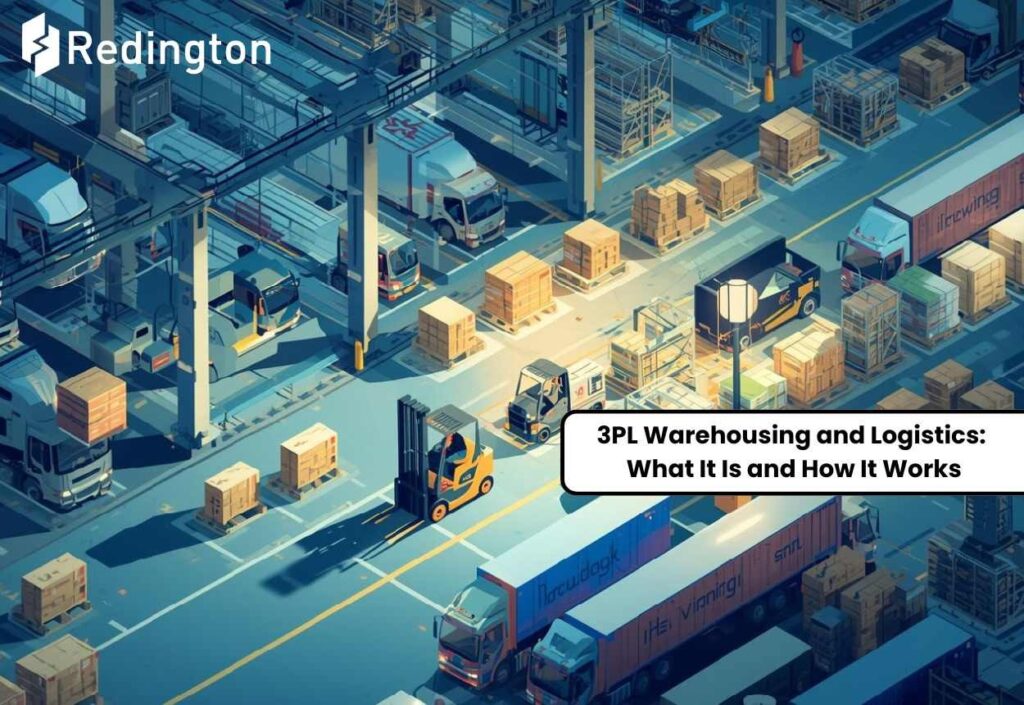
A 3PL warehouse handles the day-to-day movement and management of inventory so businesses don’t need to run their own storage operations. These facilities combine space, labour, technology, and defined processes to keep goods organised and ready for fulfilment.
Storage, Handling and Inventory Control
A 3PL manages the full storage cycle from the moment goods arrive until they are dispatched.
Putaway and Slotting: After receiving, items are scanned, verified, and placed into optimised storage locations. Fast-moving SKUs are slotted closer to picking zones to reduce walking time and improve productivity.
Storage Types: Depending on the product, 3PLs use pallet racking, shelving, bulk areas, or temperature-controlled rooms for sensitive goods like Pharma, food & consmetics.
Inventory Visibility: Most 3PLs operate through warehouse management systems that track every movement digitally, helping them maintain inventory accuracy levels of around 98 to 99 percent.
Order Fulfilment and Value-Added Services
3PLs handle picking and packing based on customer orders released through the WMS. Packing teams follow defined guidelines to protect products and maintain brand standards. Many 3PLs also offer labelling, kitting, bundling, and repacking to support promotional or ecommerce requirements.
Most 3PL logistics operations work with same-day or next-day dispatch cut-offs based on carrier schedules
Returns and Reverse Logistics
Returned products go through a structured process.
Inspection: Items are checked for condition and completeness.
Restocking or Disposition: Sellable units re-enter inventory, while damaged goods follow client-defined routes such as repair, disposal, or refurbishment.
What Do 3PL Logistics Services Include?
3PL logistics covers everything that happens outside the warehouse, ensuring goods move efficiently from suppliers to customers. These services focus on transportation, coordination, and end-to-end visibility across the supply chain.
Transportation and Carrier Management
A 3PL manages the movement of goods using different transport options depending on shipment size and urgency. Transportation planning, route optimisation, and last-mile delivery play a critical role in meeting customer service expectations.
- Transportation Modes: FTL for large loads, LTL for mixed shipments, and last-mile services for store replenishment or ecommerce delivery.
- Route Planning: Transport management systems help optimise routes, reduce empty miles, and control costs.
- Carrier Selection and Coordination: 3PLs work with multiple carriers to balance speed, price, and reliability.
- Freight Consolidation: Shipments are combined where possible to reduce cost per unit and improve loading efficiency.
Movement Across the Supply Chain
3PL logistics ensures goods flow smoothly through each supply chain stage.
- Inbound Logistics: Coordinating deliveries from suppliers or factories into the warehouse.
- Inter-Facility Transfers: Moving stock between warehouses or fulfilment centres based on demand.
- Outbound Delivery: Preparing and dispatching customer or store orders.
Most professional 3PLs work with same-day or next-day dispatch windows, depending on service level agreements.
Visibility and Coordination
Strong logistics requires clear visibility across all moving parts.
- Real-Time Tracking: TMS integrations allow businesses to see shipment status at each stage.
- Exception Alerts: Delays, damaged shipments, or route deviations trigger notifications for fast resolution.
- WMS + TMS Data Sharing: Warehouse and transport systems synchronise order movements, improving accuracy and reducing manual updates.
3PL Warehousing and Logistics: How It Works (Step-by-Step)
A 3PL combines warehouse operations and logistics movement into one connected workflow. Here’s how the full process typically works.
Step 1: Receiving Goods
Appointment Scheduling: Suppliers book inbound delivery slots so labour and dock availability can be planned.
Unloading & Verification: Products are unloaded, counted, and checked against the Advance Shipping Notice (ASN) for accuracy.
Quality Check: Damaged or mismatched items are flagged before entering inventory.
Step 2: Storage & WMS Allocation
Barcode Scanning: Each SKU is scanned into the warehouse management system (WMS) for traceable movement. Barcode validation and location assignment reduce dwell time and improve traceability.
Putaway: Inventory is placed in the correct area (pallet, bulk, bin, temperature zone).
Location Assignment: The WMS allocates the most efficient slot based on SKU velocity, weight, and picking frequency.
Most 3PLs maintain 98–99% inventory accuracy, supported by cycle counts.
Step 3: Order Processing
OMS → WMS Sync: Orders from ecommerce platforms or ERP systems flow automatically into the WMS. High-performance 3PLs maintain pick accuracy rates above 99 percent using RF scanning
Pick List Creation: The system generates optimised pick paths to reduce travel time.
Picking & Packing: Items are picked, checked, packed, labelled, and prepared for handover.
Top 3PLs target 99% pick accuracy and operate with daily cut-off times for same-day dispatch.
Step 4: Dispatch & Transportation
Loading: Packed orders are organised by route, carrier, or delivery zone. Cut-off times usually fall between 3 pm and 6 pm for same-day dispatch.
Routing Through TMS: Transport management systems plan efficient routes, consolidate loads, and assign carriers.
Movement Across the Network: Depending on the shipment type, goods move through:
first-mile pickup → mid-mile hub → last-mile delivery.
This helps reduce dwell time and ensures predictable transit.
Step 5: Returns Management
Quality Inspection: Returned products are checked for condition and documentation.
Restock or Refurbish: Sellable items re-enter inventory; others are repaired, recycled, or disposed of based on client rules.
System Update: WMS and sales channels sync inventory in real time to prevent overselling
Types of 3PL Warehousing and Logistics Providers
Different businesses need different types of 3PL support. These are the main categories you’ll find in the 3PL warehousing and logistics industry. Some 3PLs specialise in financial and information-based services, including freight audit, cost control, and analytics-driven logistics planning.
Warehouse-Based 3PL
A warehouse-based 3PL focuses primarily on storage, handling and order fulfilment. These providers manage inbound receiving, putaway, inventory control, picking, packing and dispatch. They are ideal for ecommerce, retail and FMCG brands that need accurate, scalable fulfilment without building their own warehouse operations.
Transportation-Based 3PL
Transportation-based 3PL providers specialise in moving goods across the supply chain. Their strength is in managing freight from full truckload (FTL) and less-than-truckload (LTL) movements to cross-border delivery and carrier coordination. Businesses choose these 3PLs when reliability, routing efficiency and transport cost control are the top priorities.
Integrated 3PL Providers
Integrated 3PLs combine warehousing and logistics services under one system, making them the most common model today. They manage storage, fulfilment, transport, last-mile delivery and returns using connected WMS and TMS platforms.
Specialised 3PL Services
Some industries require dedicated handling and compliance, so specialised 3PLs provide tailored solutions. Cold-chain 3PLs manage temperature-controlled goods, hazardous-goods providers ensure safe and compliant handling, and bulky-cargo specialists handle large or heavy items that require special equipment and routing.
How 3PL Warehousing and Logistics Work Together with example
Real operations work best when warehousing and logistics run as a single connected system. These simple scenarios show how a 3PL coordinates storage, fulfilment and transportation to keep goods moving without delays.
A Growing Ecommerce Brand
A fast-scaling ecommerce business often struggles with limited storage, slow self-fulfilment and rising order volumes. A 3PL warehouse solves this by storing inventory in organised racks, managing putaway and maintaining high inventory accuracy through a WMS.
FMCG or Retail Distribution
FMCG and retail brands operate with fast-moving SKUs, bulk shipments and frequent replenishment cycles. A 3PL supports this by receiving pallets in large volumes, storing them efficiently and allocating stock to high-turnover zones.
3PL Warehousing and Logistics in the UAE
The UAE’s location between Asia, Europe and Africa allows fast access to major trade corridors, making it a natural base for 3PL operations. Free zones and multimodal transport links simplify storage, handling and cross-border movement without heavy delays.
Businesses use the UAE as a central stock point because GCC markets can typically be served within one to three days by road or air. This setup reduces regional warehouse requirements and keeps deliveries consistent across multiple countries.
How ProConnect Supports 3PL Warehousing and Logistics
ProConnect operates as a unified 3PL provider with capabilities that support both storage and movement of goods.
Key capabilities include:
- Bonded and non-bonded warehousing options suitable for regional and international trade
- Temperature-controlled zones for sensitive or regulated products
- WMS-driven inventory visibility with barcode-based accuracy
- TMS-supported routing, carrier coordination and shipment tracking
UAE and GCC Distribution Expertise
ProConnect works across major UAE logistics hubs and supports movement of goods into GCC markets.
Operational strengths include:
- Familiarity with regional transport routes and cross-border procedures
- Experience handling multi-country distribution schedules
Frequently Asked Question
What is 3PL warehousing and logistics?
3PL warehousing and logistics refers to outsourcing storage, fulfilment and transportation operations to a specialised provider. The 3PL handles inventory, picking, packing and the movement of goods across the supply chain while the business focuses on core operations.
What is the difference between 3PL warehousing and 3PL logistics?
3PL warehousing focuses on storage, inventory control and fulfilment activities inside the facility. 3PL logistics manages transportation, routing, carrier selection, and the movement of goods across locations. Both functions work together to complete the end-to-end process.
What type of companies use 3PL services?
Companies across ecommerce, retail, FMCG, manufacturing and cross-border trade use 3PL services. Any business that stores products, ships frequently or needs faster fulfilment can benefit from third-party logistics support.


 APP DOWNLOAD